
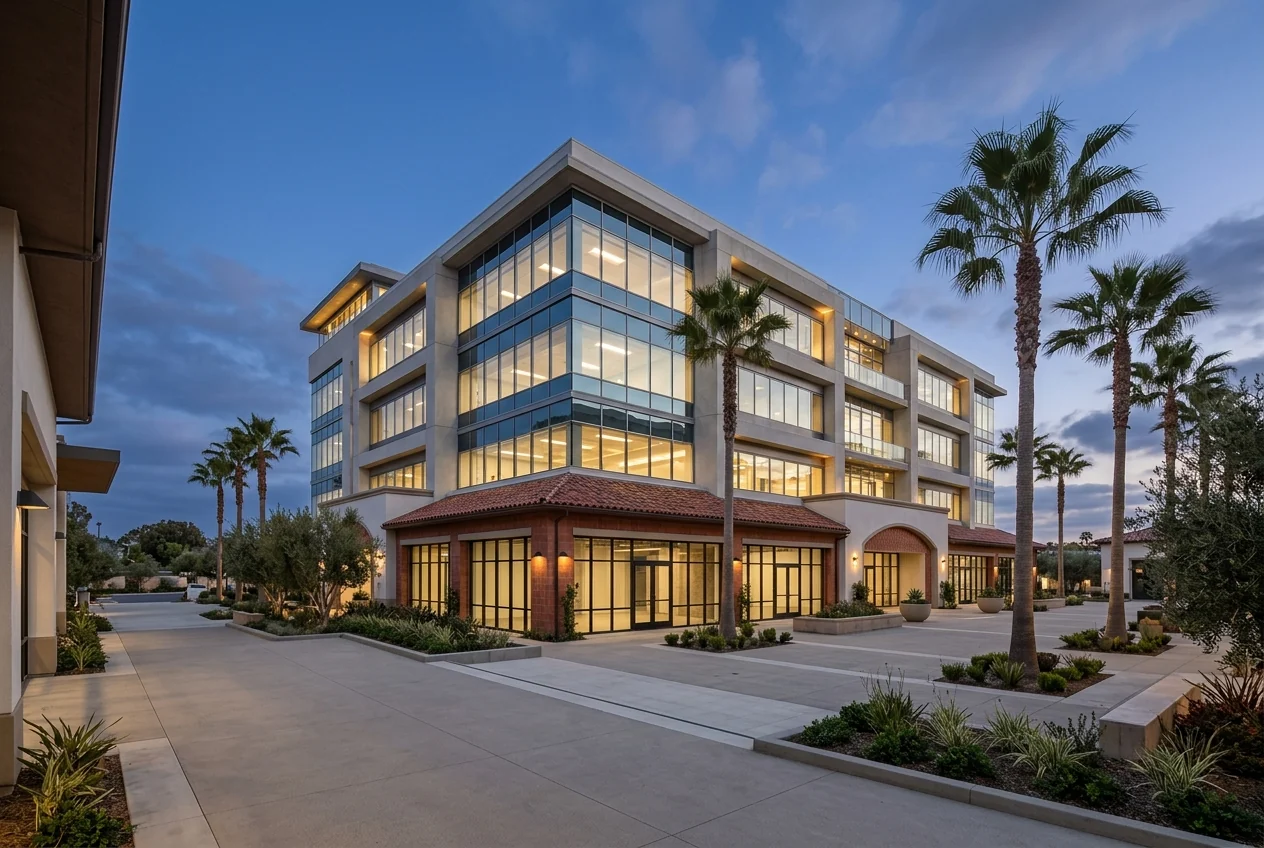
Commercial property insurance for owners.
Your building, your rent roll and your leases belong in the same review. Start with what the lease requires and what it would cost to rebuild.
The short answer.
A commercial property owner typically insures the building at replacement cost, loss of rents (rental income) after a covered loss, and premises liability for common areas, while tenants insure their own contents, improvements they own and operations, as the lease directs. Gaps appear where the lease and the policies do not match.
Insurance Steel Brokers reviews coverage for retail, office, industrial, mixed-use and small multi-tenant buildings across Carlsbad, North County San Diego and California. This page is for commercial lessors; residential rentals are covered on our landlord page.
Owner vs. tenant: who usually insures what
Typical splits only. The lease controls.
| Item | Owner (lessor) | Tenant |
|---|---|---|
| Building structure | Usually the owner | Sometimes required under NNN or single-tenant leases |
| Tenant improvements | Depends on lease | Often the tenant, if it paid for them |
| Lost rent after a loss | Owner: loss of rents | Tenant: its own business income |
| Common-area liability | Owner | Tenant for its premises; names owner as additional insured |
Related coverage to review.
Lease clauses, loss of rents and tenant mix.
Valuing the building correctly.
Common areas, parking lots and walkways.
Higher liability limits above GL.
Value the building at replacement cost.
Insure the building for what it would cost to rebuild, not its market or appraised value. Coinsurance clauses can reduce a claim payment if the limit is too low. Ordinance or law coverage addresses code upgrades and demolition of undamaged portions, which can be significant for older buildings.
Ask whether an agreed value endorsement is available to suspend coinsurance, and update values after renovations.
Loss of rents and the period of restoration.
Rental income coverage pays lost rent from a covered loss until the space is restored, subject to limits. Southern California permitting and construction can take longer than expected, so consider an extended period of indemnity for re-leasing time.
Include pass-through charges such as taxes, insurance and CAM in the rental value if your leases collect them.
Leases, NNN clauses and tenant certificates.
Triple-net leases often pass property costs to tenants, but the owner usually still places the building policy. Some single-tenant leases require the tenant to insure the building; avoid duplicate or missing coverage by matching the policy to the lease.
Require tenants to carry liability naming you as additional insured, waivers of subrogation where appropriate, and coverage for their improvements. Collect certificates and endorsements every year.
What underwriters ask.
Year built and updates to roof, electrical, plumbing and HVAC; construction type and sprinklers; occupancy and tenant list; vacancy; loss history; and distance to brush for wildfire exposure.
Restaurant, auto, manufacturing or cannabis tenants can change underwriting for the entire building. Report tenant changes promptly.
Common gaps.
Building limits below replacement cost. Loss of rents too short for a real rebuild. No ordinance or law coverage on an older building. Vacancy clauses that limit coverage after a tenant leaves. Missing tenant certificates or endorsements. Earthquake and flood excluded without a decision to buy or decline them.
Equipment breakdown for building systems such as HVAC, elevators and electrical gear is often overlooked.
What to gather for a property owner review.
- Building details: year built, square footage, construction, updates
- Rent roll, lease insurance clauses and pass-through charges
- Tenant list with operations and certificates
- Current policy declarations and any appraisal
- Five years of loss runs and vacancy history
Questions worth asking.
- Does my policy cover lost rent after a fire?
- Only if you carry loss of rents or rental income coverage, and only for covered causes and the period stated.
- Who insures tenant improvements?
- The lease decides. Often the tenant insures improvements it paid for. Coordinate both policies.
- What is coinsurance?
- A clause that can reduce a claim payment if the building is insured for less than a required percentage of its value. Replacement-cost limits and agreed value help.
- Is earthquake included?
- Usually not. It is typically separate and should be a deliberate decision.
A local team in Carlsbad.
Serving Carlsbad, Oceanside, Vista, San Marcos, Encinitas, Del Mar, Rancho Santa Fe, Escondido, Poway, Fallbrook, Valley Center, Ramona, the rest of San Diego County and clients statewide in California. Reach out before visiting so we can arrange time to discuss your questions.
Contact our Carlsbad office2870 Whiptail Loop Ste 223
Carlsbad, CA 92010
Monday–Friday · 8:30 AM–5:30 PM Pacific
Further reading.
The lease decides who insures the building, the improvements and the liability. Read it before you buy coverage.
The building, the tenant operation and the lease belong in the same conversation—but they do not create identical insurance responsibilities.
A building’s selling price, the limit on a declaration and the amount a policy pays are three different concepts.
Insurance Steel Brokers · Independent insurance guidance
Talk with Nathan Norman, property & casualty
California License #0L80995
Meet Nathan NormanOfficial California resources
Coverage is subject to insurer approval, property or business eligibility, underwriting, limits, deductibles and policy terms. Examples are not promises of coverage. A quote request does not bind or amend insurance. Market availability can change.